
How to Fix SSH Too Many Authentication Failures
Stop SSH from offering too many keys by identifying the effective identities, controlling ssh-agent, and configuring IdentitiesOnly safely.
Too many authentication failures usually does not mean you entered the wrong password too many times. It often means your SSH client or agent offered several keys before reaching the correct one, and the server disconnected after exceeding MaxAuthTries.
Confirm which identities are offered
Run SSH with verbose logging:
ssh -vvv user@example.com
Look for repeated Offering public key lines. The client may be loading identities from ~/.ssh/config, default key filenames, an SSH agent, a password manager, or a forwarded agent.
Inspect the effective SSH configuration:
ssh -G example.com | grep -E '^(hostname|user|identityfile|identitiesonly|identityagent) '
Test with one explicit key
Force SSH to use only the intended identity:
ssh -o IdentitiesOnly=yes -i ~/.ssh/id_ed25519 user@example.com
If this succeeds, the server and key are valid; the problem is the number or order of identities offered by the client.
Configure the host permanently
Add a host-specific entry to ~/.ssh/config:
Host production-server
  HostName example.com
  User deploy
  IdentityFile ~/.ssh/id_ed25519_production
  IdentitiesOnly yes
Then connect using the alias:
ssh production-server
Keep IdentitiesOnly yes scoped to hosts that need it unless you understand how a global setting affects your other connections.
Inspect the SSH agent
List public fingerprints loaded in the current agent:
ssh-add -l
You can remove a specific identity with:
ssh-add -d ~/.ssh/old_key
Avoid clearing the entire agent on a shared development session unless you know which applications and connections depend on it.
Check jump hosts and agent forwarding
A ProxyJump connection can involve identities for both the bastion and destination. Agent forwarding may also expose a larger identity set on the intermediate host. Use separate Host entries and explicit keys for each hop.
Do not enable agent forwarding by default. A compromised remote host can use a forwarded agent while the session remains active.
Diagnose it with Rumus
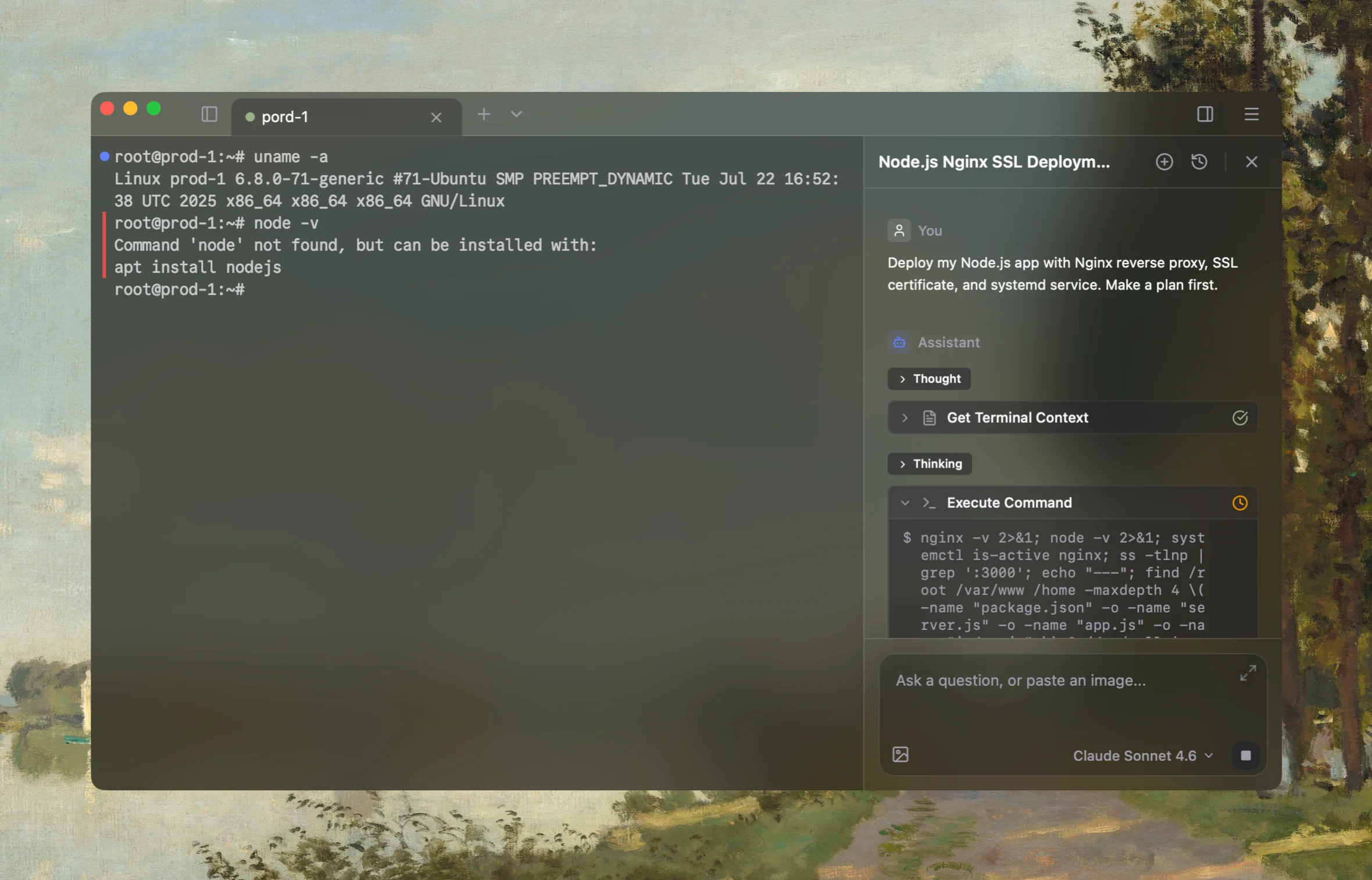
Rumus is an AI-native terminal that connects to your real SSH hosts and understands the active connection context. It can inspect SSH configuration, identities, network paths, and server logs instead of guessing from an isolated chat.
What Rumus can inspect
- SSH config, keys, and effective connection settings
- Jump hosts, proxies, ports, and network reachability
- Server authentication logs and file permissions
Diagnose this SSH Too many authentication failures error. Show the effective SSH
configuration, every identity source and offered key fingerprint, ssh-agent state,
and any jump-host or forwarding configuration. Recommend the smallest host-specific
change. Do not remove agent keys or edit SSH config without approval.
Confirm the fix
Reconnect with verbose logging:
ssh -vvv production-server
The client should offer only the intended identity, and the server should proceed to successful authentication instead of disconnecting after several attempts.
Open the server in Rumus and let the AI agent inspect context, propose a plan, and ask before it runs changes.