
How to Fix Kubernetes TLS Handshake Timeout
Diagnose kubectl and Kubernetes API TLS handshake timeouts by checking context, DNS, proxies, load balancers, API server health, and client latency.
net/http: TLS handshake timeout from kubectl means the client established or attempted a network path to an HTTPS endpoint but did not complete the TLS handshake before its deadline. The cause is usually latency, packet loss, a proxy or VPN, an unhealthy load balancer, API server saturation, or an endpoint that is not actually serving Kubernetes TLS.
Confirm the effective API endpoint
kubectl config current-context
kubectl config view --minify --raw -o jsonpath='{.clusters[0].cluster.server}{"\n"}'
Use --raw carefully because the complete kubeconfig may contain credentials. The JSONPath above prints only the server URL.
Confirm the context belongs to the intended cluster and that environment variables do not unexpectedly route traffic through a proxy:
env | grep -Ei '^(http|https|no)_proxy='
Test DNS and TCP reachability
Extract the API hostname from the configured URL and inspect its addresses:
getent ahosts API_HOSTNAME
nc -vz -w 5 API_HOSTNAME 443
Use the configured port if it is not 443. Test each returned address when behavior is intermittent. A stale address or unhealthy load-balancer backend can make only some attempts time out.
A successful TCP test does not prove TLS or the API server is healthy; it only confirms that a connection reached a listener.
Inspect the TLS handshake directly
openssl s_client -connect API_HOSTNAME:443 \
  -servername API_HOSTNAME -brief </dev/null
This separates TLS negotiation from Kubernetes authentication. Verify that the endpoint presents the expected certificate chain and responds consistently.
Do not use --insecure-skip-tls-verify as a timeout fix. Certificate verification happens after enough of the handshake completes, and disabling it hides identity problems without repairing latency.
Compare VPN and proxy paths
Corporate proxies, VPNs, service meshes, security agents, and bastions can intercept or delay TLS. Compare the route from another approved network or a host in the cluster’s private network.
For a direct or private Kubernetes API endpoint, ensure NO_PROXY covers the exact API hostname, domain suffix, and address ranges required by your environment. Avoid adding broad exclusions that bypass mandatory inspection for unrelated destinations.
Measure request behavior
kubectl --request-timeout=10s get --raw='/readyz?verbose'
kubectl -v=8 get namespaces
Verbose client logs show DNS, connection, and request timing, but can also contain headers or other sensitive details. Redact them before sharing.
If the TLS handshake succeeds but /readyz or normal requests remain slow, the problem has moved beyond transport to the API server or its dependencies.
Check control-plane and load-balancer health
For a self-managed cluster, use an approved control-plane access path:
kubectl get --raw='/readyz?verbose'
kubectl get pods -n kube-system -o wide
Inspect API server, etcd, authentication webhook, and load-balancer health and latency. On managed Kubernetes, review provider health events, control-plane logs and metrics, endpoint access settings, quotas, and regional networking.
One overloaded or unreachable control-plane backend behind a load balancer can produce intermittent handshakes. Compare source addresses, backend selection, and failure timing before restarting components.
Check MTU and packet loss
TLS handshakes exchange packets larger than a simple TCP SYN. VPN or overlay MTU problems can allow the port test to succeed while certificate packets stall. Compare packet loss and path MTU according to network policy:
ping -c 5 API_HOSTNAME
tracepath API_HOSTNAME
ICMP may be filtered, so missing replies alone do not prove the cause. Correlate them with packet captures or network telemetry when authorized.
Diagnose it with Rumus
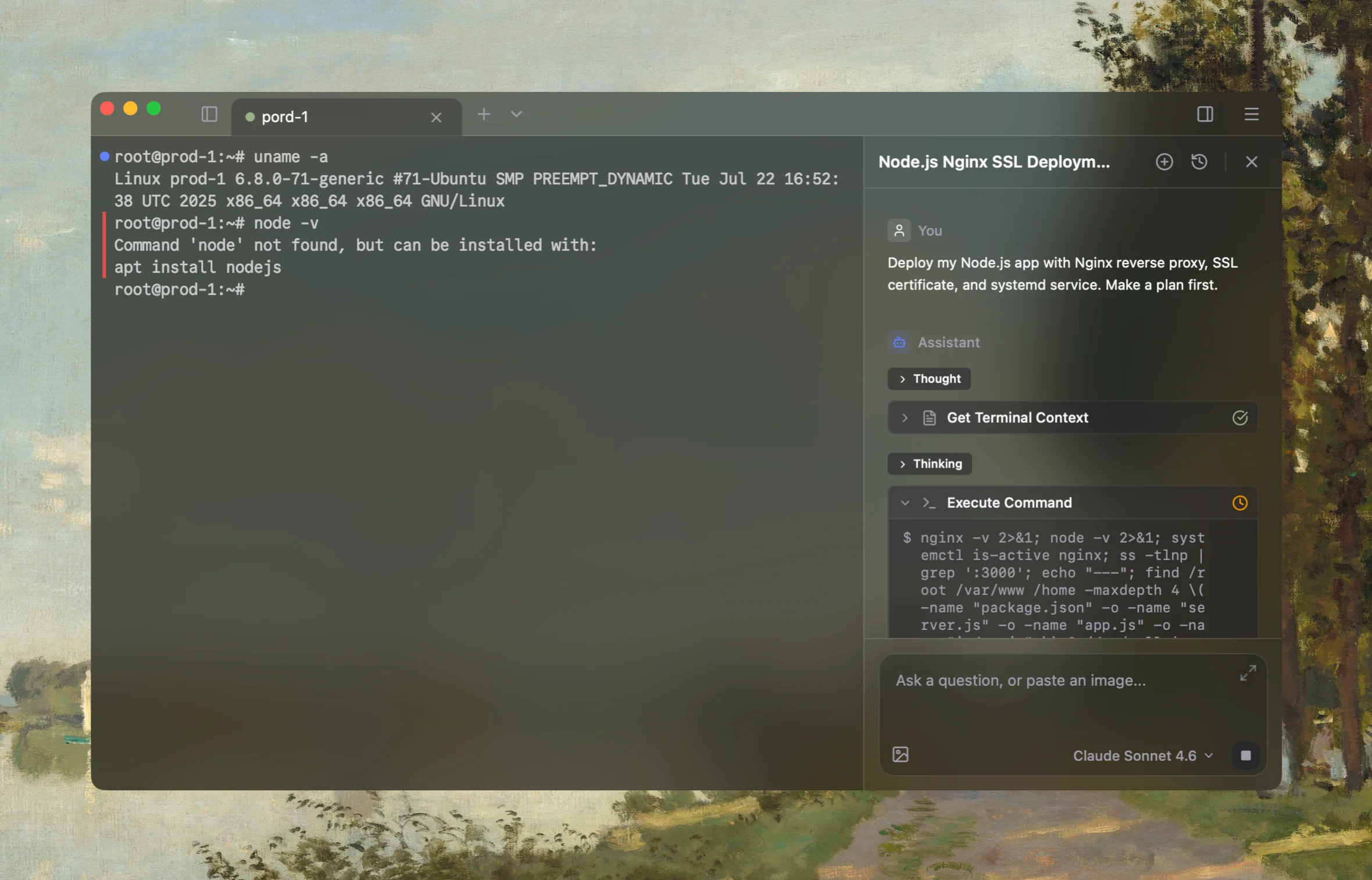
Rumus is an AI-native terminal that can use your current Kubernetes context to correlate pods, events, logs, controllers, resources, and nodes. It keeps the investigation read-only until you approve a proposed change.
What Rumus can inspect
- Pods, events, previous logs, and owning controllers
- Resources, probes, scheduling rules, and node state
- Secret-aware output and approval before cluster changes
Diagnose this kubectl TLS handshake timeout. Confirm the current context and API
server URL without exposing credentials; inspect DNS answers, TCP and TLS timing,
certificate identity, proxy and NO_PROXY settings, VPN and routes, per-address
behavior, load-balancer and control-plane readiness, API server and etcd latency,
packet loss and MTU. Start read-only and do not bypass TLS verification, change
proxy policy, restart control-plane components, or alter endpoint access without
approval.
Confirm the fix
Repeat several TLS and API requests through the original network path:
kubectl --request-timeout=10s get --raw='/readyz'
kubectl get namespaces
Confirm handshakes complete consistently across every resolved endpoint, API latency returns to baseline, the certificate is still verified, and no temporary insecure or overly broad proxy bypass remains.
Open the server in Rumus and let the AI agent inspect context, propose a plan, and ask before it runs changes.